what kind of habitat do tigers need to survive?
- What practise Tigers demand to survive? Permit's get clarified
- ✱ What do Tigers need to survive in the wild?
- ✱ What do Tigers demand to survive in the zoo?
- ✱ What are Tigers' notable adaptations that help them survive?
- Practise Tigers demand shelter?
- How does a Tiger survive in its environment?
- What volition happen if Tigers go extinct?
- How can we help Tigers survive?
What do Tigers need to survive? Let's get antiseptic
Tiger (Panthera tigiris) is the largest surviving large cat on planet earth. Information technology can weigh xc to 310 kgs on average. And, there are altogether six surviving subspecies of tigers surviving at present.
These 6 surviving subspecies of tigers are Amur tiger, Bengal tiger, Indochinese tiger, Malayan tiger, South China tiger, and Sumatran tiger.
The largest big cat is the Amur tiger (Siberian tiger), with males having a weight of up to 660 pounds and measuring upwards to 10 feet in length from nose to tip of the tail.
And, India has the largest population of Tigers in the globe with most of the tigers living in modest isolated pockets.
Tigers are listed in the ICUN Ruddy List of Threatened Species as Endangered species. Pregnant that they are very likely to become extinct in the near future due to their decreasing population.
Major reasons for their population decline are habitat destruction, habitat fragmentation, and poaching due to the various human-wild fauna conflicts occurring in the high homo population density regions.
So, at present, in that location is a high need to work for the survival of this species in lodge to protect it from getting extinct. So, in that location is of high importance to acquire about their needs for survival.
And then, let's go cleared about What do Tigers need in gild to survive so that nosotros can know more about this endangered species and its survival needs and crusade.
Let'south get started. So, keep reading…
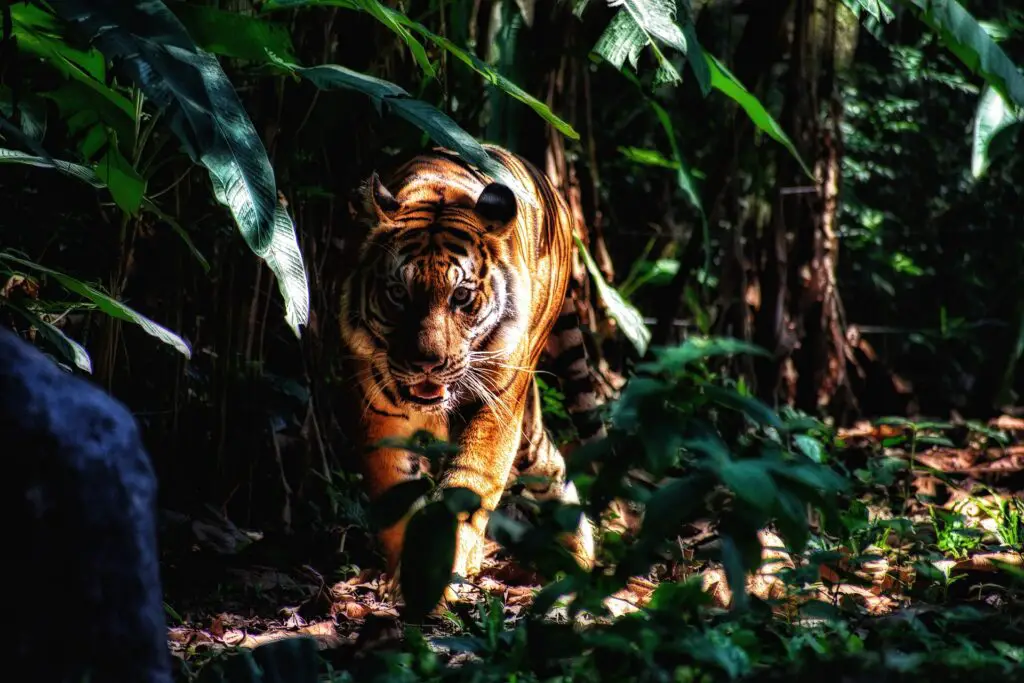
✱ What exercise Tigers demand to survive in the wild?
First of all, they will need their type of habitat with easy access to water and prey. They e'er prefer places where they tin can easily cover-up and so tin can maintain their position as an ambush predator.
Depending on the species they tin stay in rainforests, grasslands, savannas, and even mangrove swamps. But like the Bengal Tiger that is well-adapted to living in Mangrove swamps.
They tin can tolerate staying in a slap-up variety of environments where nights can be as cold equally −40 °C to the mangrove swamps with the temperature reaching more than xl °C.
They prefer having large copse, rivers, and swamps in their areas. It'southward because they can be also seen bathing and swimming in the water, and even climbing up the trees to spectate over their territory and prey.
Tigers are by and large nocturnal (more active at nighttime) and so they prefer areas where at that place's adept availability of casualty at nighttime or during the dawn or sunset fourth dimension of the day.
An adult male tiger can eat about xl kg of meat at one time with which it can survive for at least a week. And then, they prefer living in those areas where there is skillful availability of large-bodied casualty population for them to feed on.
They prefer preying on large-bodied animals like moose, deer, elk, pigs, cows, horses, buffalos, elephant cubs, rhinoceros calves, wild dogs, and goats in order to fulfill their dietary needs.
✱ What do Tigers need to survive in the zoo?
Tigers stay at the utmost care under the proper surveillance of zookeepers and veterinarians when they are in the zoo.
And then, in that location's no issue for any human-tiger disharmonize or whatever major health bug that can to negatively bear upon their existence.
In zoos, their living area must mimic their wild habitat type. It is always best if the tigers' habitat in the zoo is congenital equally split bio-secure units within the rehabilitation facility.
A bio-secure unit must be designed in such a fashion that at that place is a solid-walled den or cage for the tiger to sleep with a small outdoor enclosure which will exist widely connected to a large outdoor identify for the tiger to spend about of its time.
The solid-walled den or cage must exist small, simple, solid-walled, well-ventilated, and roofed having a suggested area of at least 3m x iii.5m.
The inner side of the den must exist dark with only a very dim calorie-free within it.
When in the outdoor enclosure there must be enough shaded expanse for the tiger. They like to breast-stroke very oftentimes in order to thermoregulate themselves, so in that location should also be a small water body or pond for them.
Diets for tigers can include whole torso casualty or carcasses of beef, goat, or deer. They must be provided with 4 to eighteen kgs of meat or meat that is 5 to 6% of their approx body weight at least five times a calendar week.
They must be provided with fresh, portable, chlorinated mineral drinking h2o at regular intervals. The drinking water tank must be well-cleaned and hygenated at to the lowest degree afterwards every two to three days.
✱ What are Tigers' notable adaptations that assist them survive?
Their power to cover-up is noteworthy due to their striped coat. This helps them to better alloy with their surround and remain subconscious from the vision of their prey.
When in the deep wild, they act mostly nocturnal so tin be seen mostly hunting at the night, dawn, or dusk time.
They tin see conspicuously in the dark because they have more than rods than the cones in the retina of their eyes.
Tigers have white spots surrounded by blackness fur on the back of their ears. This helps the tiger to give false alarms of their presence to other animals making those animals recall that the tiger is watching them so this also discourage other animals from attacking the tigers from behind.
They are known for their hunting skills to slowly and quietly follow their noticed prey, sneak without being noticed past the prey, and and then give a surprise attack. That's why they are also called deadfall predators.
Their potent and long hind limbs, flexible spines and strong muscles, powerful jaw with large canine teeth, and razor-sharp forelimb claws help them to kill big prey with a sudden surprise attack at just ane powerful bite.
Their powerful jaw is equipped with an array of teeth for killing, chewing, tearing, and bitter purposes.
With large canine teeth (two.v to three inches) they can evangelize two times more than biting strength than a panthera leo, thus leading to the faster killing of their casualty.
Their sense of smell and hearing is very stiff. This amend helps them to hunt and secure their territorial boundaries and so well. However, their sense of olfactory property is not and then good every bit other big cats.
Using their sense of hearing they are finely able to communicate and listen through infrasound (audio waves below a frequency of 20 Hz) which is really inaudible to most other species.
They stay and hunt alone. Although, the mothers stay with their cubs. This aids them in giving the benefit of hunting in stealth and then amend chances of survival due to fewer responsibilities as compared to living in a group.
Due to their larger size and greater forcefulness, they tin easily knock their prey off remainder. And then they effort to accept down their casualty with a very powerful bite to the neck and/or throat and so then suffocating the prey to death.
Tiger cubs can follow their mother through alpine grasses very hands by precisely following the mom'southward long tail and white-spotted ear from the dorsum. This besides ensures the cubs' learning and a good charge per unit of survival.
Do Tigers need shelter?
Yep, just like any other fauna tigers also need shelter. They make their shelter under the canopy of large shaded trees, inside natural copse and shrubs covered caves, inside rocky caves, dens, densely grass-covered locations, crevices, or even in the hollow of a big tree.
They don't make their shelter. In fact, these lone animals do have over new territory and conform for themselves a new shelter in their native surround all within their own territory.
In order to hide their cubs, mother tigers have been known to make dens under the darkening of the thick bushes and trees.
Female parent tigress does this in society to go on her vulnerable cubs hidden from other tigers for around 6 months at to the lowest degree until they are old plenty to feed on prey brought past their female parent.
Their shelter keeps them away from blowing air current, harsh climatic weather condition, and heavy rainfall which in turn helps them to maintain their body homeostasis.
They are often seen making their shelter near to the water bodies where they tin swim. Their territories will take long copse on which it can climb upwards to spectate its prey and whatsoever invading brute.
Taking the example of the Bengal Tiger, it is normally found near tall grasses in the tall copse amidst the mangrove swamps, considering the tiger needs a skillful identify to hide from its casualty and to stem on them all near to the h2o bodies.
Also, for those tigers that live inside dens and rocky shades, aid them to amend camouflage and hide from their preys' vision. And, besides to act as ambush predators by staking their prey from inside their shelter very oft.
How does a Tiger survive in its environment?
Tigers survive in their environment due to their power to camouflage, sneak up and practice a surprise attack, stealthy hunting habits, due to having a strong powerful body and jaws, its ability to climb trees and swim, mate and breed all around the twelvemonth (mostly between May to June months), ability to better thermoregulate, ability to withstand temperature as common cold as −40 °C to temperature reaching more than than forty °C.
And besides that they are apex predators, so there's no danger for the adult tigers to be hunted by another predator.
Tigers serve as apex predators and the largest carnivore in their ecosystem. And so, they command natural prey populations without themselves being preyed upon by other animals.
They need water to drink and swim. So, they can be seen living well-nigh the h2o ponds and large water swamps.
They accept been oftentimes seen swimming and crossing the big water bodies for territorial investigation, locomoting from one place to another, for hunting purposes, and by and large to thermoregulate their body temperature.
Tigers due to the presence of big claws, large teeth, and powerful forelimbs can very easily hold other animals down and impale them with a unmarried powerful bite. Due to this ability, they don't accept to work much harder to take down prey.
Also due to their strong flexible spines, powerful and long hindlimbs, they tin can jump upwardly to 33 feet in a single leap. This gives them their ability to meliorate swim, run and capture casualty, so to blend in their ecological niche very well.
What volition happen if Tigers go extinct?
Tigers being apex predators deed so well in club to stabilize the ecological balance by keeping a check on the prey populations.
In doing so, they continue a balance over the various ecological niches and the food chain and nutrient web ecosystems.
This in turn promotes the harmony of the planet's ecosystems while maintaining the proper energy flow.
So, protecting the tigers is very much important.
So, if tigers become extinct then it will create an imbalance in the preys' population which in turn will disbalance the energy flow, various food webs and food chains, and besides the ecology conditions straight or indirectly in the blazon of ecosystem the tigers are in.
Tigers mostly feed on carnivores similar cows, deers, buffaloes, etc. So, tigers' being will keep these prey'due south population in limit so, in turn, will go on the balance on the woods vegetation availability which these carnivores feed upon besides.
And so, protecting the tigers volition besides safeguard the availability of various critically important goods and services of the wild that millions of people rely on every day.
As well due to the balance on the forest vegetation, it will highly mitigate climate change. This will enrich afforestation and so will also maintain the clean and fresh oxygen availability in the air.
These forests volition also human action as critical carbon storage warehouses for the ecosystem and so for nature altogether.
They will also play a key part in regulating the flow of freshwater, maintaining a great ecological balance, balancing the growth of prey and predatory species if a skillful residuum in the existence of tiger population in the ecosystem is conserved.
How can we help Tigers survive?
First and foremost, it is our responsibleness to make ourselves enlightened of the various knowledge-worthy data and insights nigh the endangered tigers, and too to enlightened others of the aforementioned.
Nosotros assistance Tigers survive and protect them from getting extinct by taking various steps for conserving the tiger population in wild fauna sanctuaries, tiger reserves, national parks, and in the various bio-secure zoos, conservation intendance habitats, various rehabilitation facilities, etc.
The homo-animal disharmonize must be greatly reduced. Like deforestation, poaching tigers and their prey animals, excessive tourism close to their habitat must also be reduced considerably.
Taking consideration of their habitat protection by creating a safe identify for them in their own natural ecosystem will as well work great in this step.
Their habitat protection can exist washed by naturalists and conservationists in the various sanctuaries and forests by reducing any chances of human hunting past the tigers, or harming the species by humans, and vice-versa.
We can besides call back about attending any fundraising events for the tigers and wildlife organizations. And then, nosotros must take our turn to volunteer and work for such events and organizations whenever we can to play our role in the conservation of tigers.

Source: https://onlyzoology.com/what-do-tigers-need-to-survive-lets-know-about-it/
0 Response to "what kind of habitat do tigers need to survive?"
Enregistrer un commentaire