What Causes the Itcz to Move So Far North in Asia?
On the evening of June 11, 2015, information technology began to rain in Mumbai, Republic of india, and information technology did not terminate until the next day. Trains were delayed. A wall complanate with the added weight of water. Notices were posted well-nigh the risk of landslides in hilly areas of the metropolis. 2 people died as a issue of the rainfall. Yet at that place was a feeling of relief in the urban center. As a news commodity in the New Indian Express put it, "Bombay smiled as heavy showers lashed the urban center."
The city was smiling, and so to speak, because this tempest ended a long heat wave. Before the rain began, it was so hot during May that cobblestone roads were melting. In many places in India, boiling atmospheric condition made the heat experience much hotter. In ane location, the estrus index, which takes both heat and humidity into account to depict how hot it feels, was over 140°F. After the rain started, temperatures dropped as clouds shaded Mumbai from the sweltering sun. It was notwithstanding warm – with high temperatures to a higher place 80°F – but was much cooler than during the heat wave. The start of rains in early June marked the stop of the dry winter and the onset of the wet summertime monsoon .

Mumbai, India, during monsoon rainfall.
Indrani911basu
Monsoons produce the very wet summers and dry winters that occur on virtually all of the tropical continents. A monsoon is non a tempest like a hurricane or a summertime thunderstorm, but a much larger pattern of winds and rain that spans a large geographic area – a continent or even the entire globe.
Weather and climate are very different in the tropics and mid-latitudes, and it is not only a affair of the tropics being warmer. In Europe, North America, and other mid-latitude regions, temperatures undergo large changes over the seasonal bike; weather events in these regions terminal a few days every bit high- and depression-pressure systems drift slowly due east, rearranging the locations of warmer and colder air masses as they get. This might make it absurd and rainy 1 day and warm and sunny the side by side. In contrast, tropical temperatures don't change much throughout the year. The seasonal cycle over tropical continents is marked by an oscillation betwixt dry and wet periods brought near by monsoons. Weather condition events in the tropics – such as typhoons, thunderstorms, and other rainstorms – are actually embedded within the much larger monsoons. Billions of people live in the monsoon climates of South Asia, Africa, and the tropical Americas, and every spring they wait for monsoon rains that will end the wintertime dryness fifty-fifty though they might also cause disastrous floods. There is ofttimes too little h2o or too much.
Where Monsoons are Found
If you lot are looking for monsoons, you'll need to head to the tropics. That's where rain is produced as warm and boiling air rises in the Intertropical Convergence Zone (ITCZ), which swings north and south in a seasonal bicycle, causing patterns of distinctly moisture and dry out seasons (explore Why Monsoons Happen to learn more near how this works).
However, monsoons are not the same throughout the torrid zone, considering the specific locations of continents and oceans influence the regional patterns of winds and pelting. Classic atmospheric condition for strong monsoons are constitute where the Indian Ocean and the Pacific Ocean run across. This region includes Bharat and Southern asia to the northward of the equator and Australia south of the equator. Strong swings betwixt moisture summers and dry winters are institute in those places every bit the ITCZ moves back and forth beyond the equator. The South Asian monsoon, which includes the Indian monsoon, is especially strong because the Himalayas and other mountains block dry air in the due north from getting to the humid monsoon region. The seasonally wet and dry out region just south of the Sahara Desert in West Africa and the Sahel is another classic monsoon region. Monsoons occur in the Americas too, merely tend to exist weaker than in other regions.
The animated map below shows how atmospheric precipitation varies through a typical year. Notice that most precipitation occurs in the tropics and swings north and south of the equator with the seasons. This seasonal shift in the location of tropical precipitation indicates a shift in the location of the ITCZ and is the reason why in that location are distinct wet and dry seasons on tropical continents.
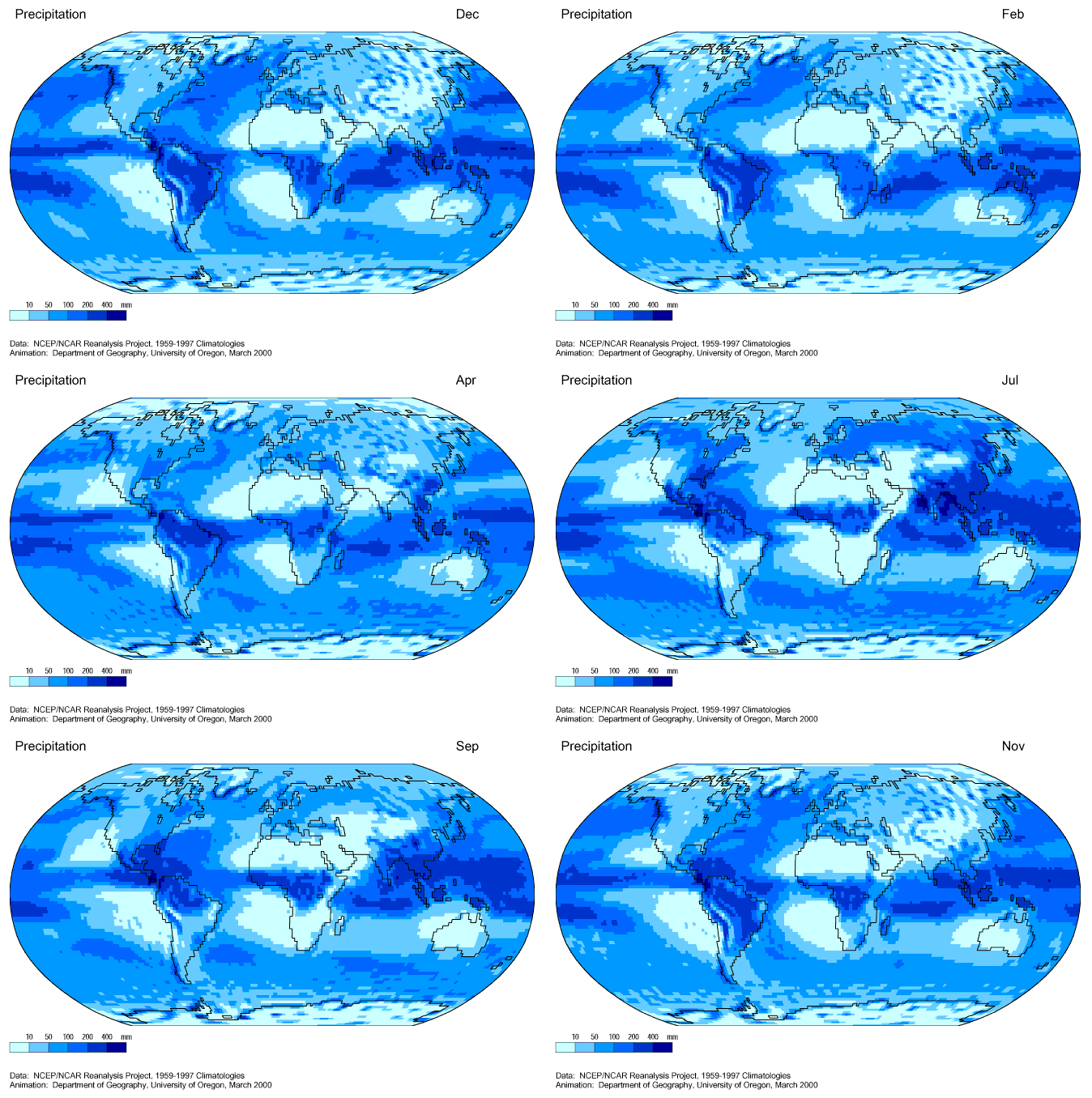
Patterns of precipitation through the yr
University of Oregon
Asia, India, and Australia
With the world's strongest monsoons, this region stretches from the Due south People's republic of china Sea into the Indian Bounding main and includes Asia and the northern cease of Australia. From June until September, summer monsoon rains occur in South Asian countries such as Vietnam, Thailand, Cambodia, People's republic of bangladesh, Laos, Republic of india, and Pakistan. From December until Feb, the monsoon rains move south of the equator towards Commonwealth of australia while Southern asia experiences dry monsoon conditions. There is even an E Asian monsoon that brings summer rain to China, Japan, and Korea, but it is caused by a different type of air current blueprint associated with the jet stream.
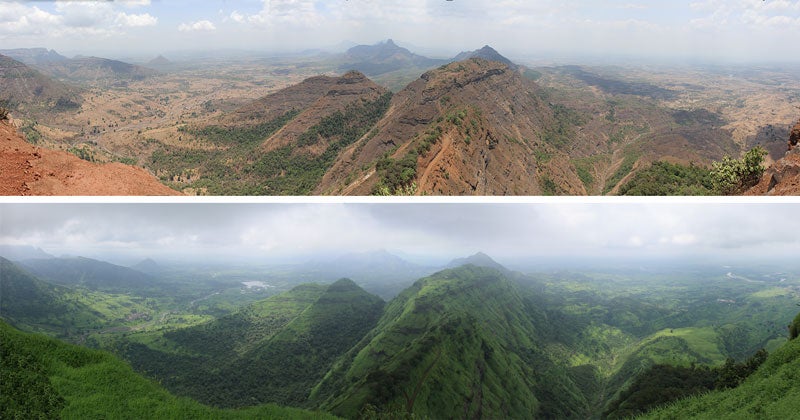
Monsoons bring big amounts of rain to a location, often leading to large-scale vegetation growth.
University of Oregon
The Americas
Monsoon winds in the tropical parts of North America, Cardinal America, and Due south America crusade the amount of rainfall to vary with the seasons, even in areas where atmospheric precipitation is plentiful and rainforests thrive. From June to Baronial, which are summer months in the Northern Hemisphere, there is more rainfall north of the equator in Republic of costa rica, Nicaragua, Panama, and western Mexico. From Dec to February there is more rainfall south of the equator in Brazil. The North American monsoon does bring moisture from the warm waters of the Pacific into the U.Southward. Southwest, but its elevation rainfall occurs in Mexico, and the U.S. states of Arizona and New Mexico lie in its periphery. These areas are typically dry just can receive plenty rainfall to quell a wildfire if moist monsoon winds blow in summertime. An area of summertime rainfall forth the U.S. East Coast is associated with what some might telephone call a mid-latitude version of monsoon rainfall.
Africa
During Northern Hemisphere summertime, the Intertropical Convergence Zone (ITCZ) over Africa lies far northward of the equator, just due south of the Sahara Desert in an surface area known as Sub-Saharan Africa. Moist winds blow from the Atlantic and produce rain once they reach Westward Africa in countries such as Mali, Niger, Ghana, and the Ivory Coast. During Southern Hemisphere summer, the ITCZ lies southward of the equator and brings rain to southern African countries such every bit Republic of zimbabwe, Tanzania, Zambia, Republic of malaŵi, Mozambique, and Uganda. Meanwhile, sub-Saharan Africa becomes particularly hot and dry in winter as air descends from loftier in the atmosphere to the ground as function of the Hadley Circulation.
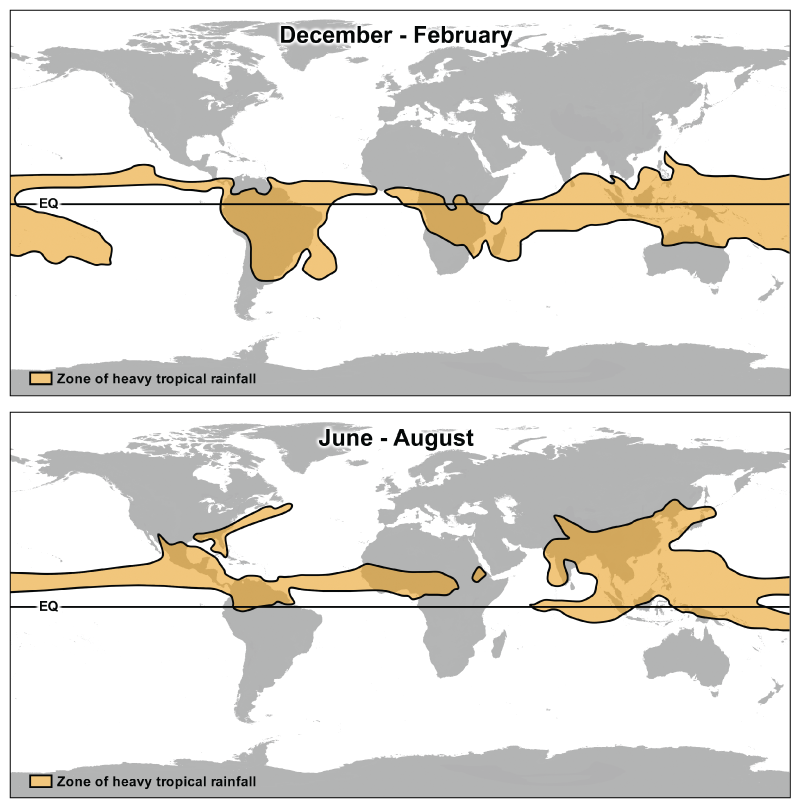
The locations of the heaviest tropical rainfall from December to February (top) and June to Baronial (bottom).
UCAR
Why Monsoons Happen
"The monsoon winds accept formally arrived in the city," Bombay Regional Meteorological Centre's manager-general Five.K. Rajeev told the Indian press on Fri June 12, 2015, after a full night of rain.
He referred to winds even though people cared more nearly the rains that had just started. That'southward because monsoon rains are controlled by the wind and, in general, by the way air moves through the tropical temper, which changes dramatically at the start and cease of every summertime.
At that place's a blueprint to the wind.
Air moves through the tropical temper in a pattern called the Hadley Apportionment – warm air rises near the equator, flows toward the poles, and then descends back toward the Globe'due south surface in the subtropics. The air flows along Earth'southward surface from the subtropics toward the equator and and then the loop starts all over once again.

Air warmed in the torrid zone rises, flows towards the poles, then downward in the subtropics, and dorsum to the equator.
UCAR
Sunlight, and the energy it brings to Earth, is the driving force backside the Hadley Circulation. Sunlight heats land and ocean surfaces near the equator. The warmed surface releases free energy into the atmosphere, in the class of oestrus and evaporated water. Air that was warmed at the equator, and the water vapor it holds, rises and spreads out in the upper atmosphere, approximately x-15 kilometers above the Earth's surface. As it flows toward the poles, this air cools and drops downward toward the surface of the Earth in the subtropics, nearly 30 degrees breadth due north or southward of the equator. Equally air rises near the equator and then flows poleward, it leaves an area of fewer air molecules at the equator. This is a region of low pressure because at that place is a smaller mass of air left over the equator. Air from the subtopics, due north and south of the equator, flows in to fill the space, completing the loop of Hadley Circulation. The surface area nearly the equator with low pressure and converging, rising winds is called the Intertropical Convergence Zone (ITCZ). Water vapor condenses every bit air rises and cools in the ITCZ, forming clouds and falling as rain. The ITCZ can exist seen from infinite as a band of clouds effectually the planet. This is where monsoon rainfall occurs.
If the Earth were not rotating, winds would accident direct towards the Intertropical Convergence Zone from the northward and due south. But the Earth is rotating – making a full turn on its centrality each day – which turns the current of air to the right in the Northern Hemisphere and to the left in the Southern Hemisphere. This means that air flowing toward the equator near World's surface also flows toward the westward, and makes up what we call the "trade winds", which were important for global merchandise back in the days when goods were transported between continents by sailing ships. The issue of Earth'south rotation on the winds is chosen the Coriolis outcome or Coriolis forcefulness. It as well affects the movement of ocean currents and the management of rotation in hurricanes. Motions that span hundreds to thousands of miles feel the Coriolis forcefulness. It does not impact smaller scale phenomena like tornadoes. (And reverse to legend, the management that water spins in a flushing toilet is due to toilet blueprint, as toilets are much besides small to feel the Coriolis strength.)
The way the trade winds turned to the west on their way to the equator was of great interest to George Hadley, an 18th Century British lawyer who dabbled in meteorology. He proposed that information technology was the spin of the World that caused the winds to turn as they blew towards the equator. He produced what was essentially the commencement global theory of atmospheric circulation. Over the years other scientists accept refined and farther developed these ideas, simply Hadley did get some of the basics right. Today, the Hadley Circulation in the tropics is named after George Hadley.
The Hadley Circulation doesn't stay in the same place year-round, but varies with the seasons. This is the key to understanding why many tropical regions around the world have patterns of wet monsoon summers and dry winters. The seasonal changes in the Hadley Circulation create the earth'due south monsoons.
Winds modify through the year.
During Dec and January, the Southern Hemisphere is heated more strongly by the sun than the Northern Hemisphere, so the hottest air – the air that rises in the ITCZ – is found a little south of the equator. Winds from the Northern Hemisphere accident across the equator towards the ITCZ. During June and July, the Northern Hemisphere is heated more strongly past the lord's day, so the ITCZ and its rising hot air lie a piffling north of the equator and winds blow from the Southern Hemisphere across the equator to accomplish the ITCZ in the Northern Hemisphere.
Equally the ITCZ changes location through the year, the winds and rains and the location of monsoon wet weather changes, likewise.

Equally the Intertropical Convergence Zone (ITCZ) changes location through the year, the winds, rains, and the location of moisture monsoon atmospheric condition changes, also. In this instance from Asia and Commonwealth of australia, the ITCZ moves from the Southern Hemisphere (left map) to the Northern Hemisphere (right map).
UCAR
Remember that the Coriolis force changes direction on the equator: It turns winds toward the right in the Northern Hemisphere and to the left in the Southern Hemisphere. And so when air crosses the equator as it flows from the common cold winter hemisphere toward the ITCZ in the summer hemisphere, it experiences a change in the Coriolis force. This causes the merchandise winds to reverse management and blow toward the w in the winter hemisphere and to the east in the summer hemisphere. This seasonal reversal of the winds was historically very important for trade betwixt Africa and Asia; ships would sail from Asia to Africa in winter then undertake their return voyage when the summer monsoon changed the air current from due west to eastward.
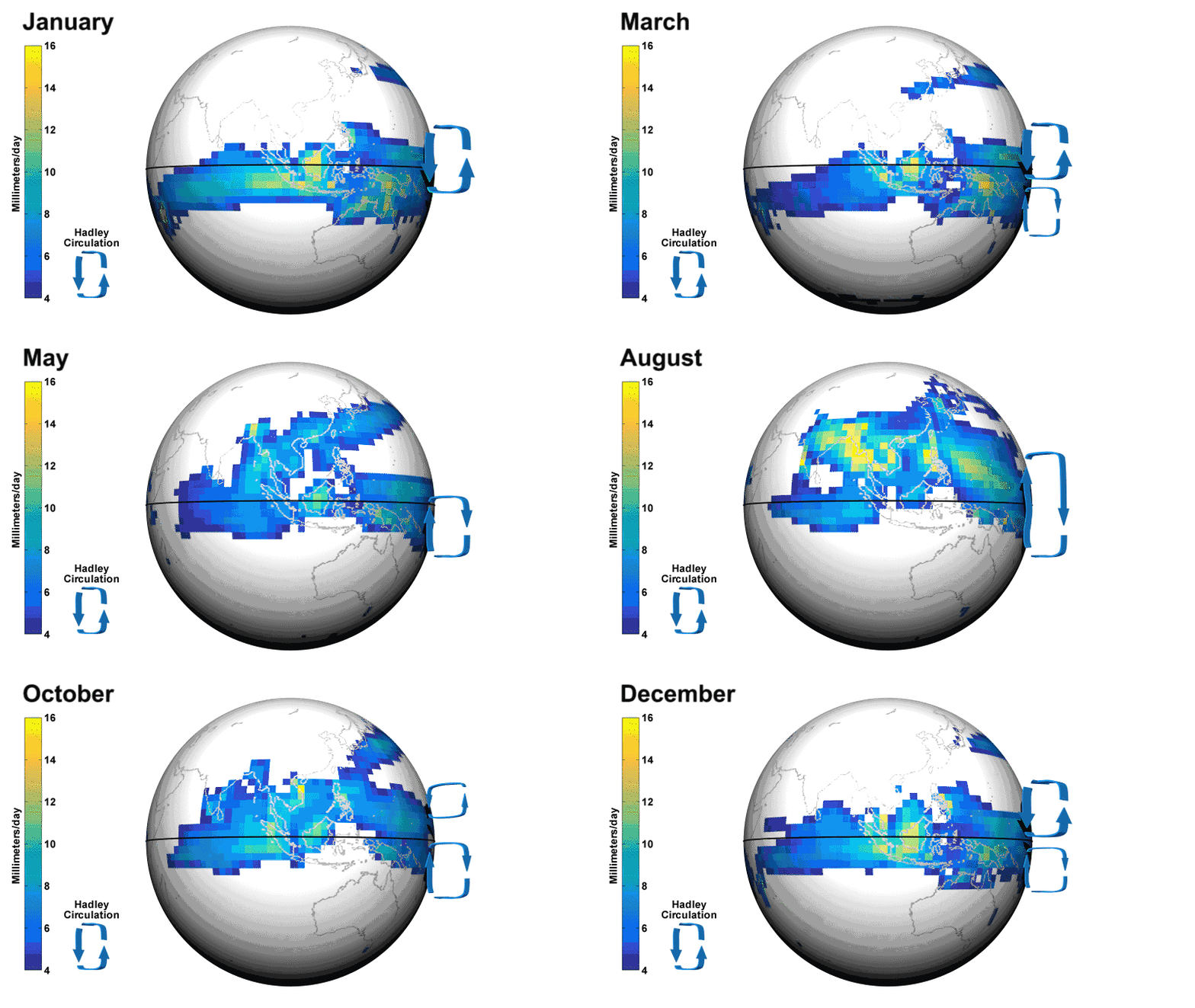
The blitheness to a higher place shows how the ITCZ, winds, and rain patterns change through the months of the year.
UCAR
The summer monsoon is what people frequently think of equally monsoon atmospheric condition: large amounts of rain. But the wintertime monsoon, where dry weather condition prevail, is part of the blueprint too. During wintertime, air descends over tropical continents equally the part of the Hadley Circulation that is exterior of the ITCZ. Descending air causes high force per unit area, and makes clouds and rain uncommon. The dry conditions during wintertime can even pb to drought if they are too intense or persist for too long.
Monsoons are affected past geography.
Geography affects the corporeality of rainfall that an expanse receives equally the ITCZ moves through the seasons. For example, during Northern Hemisphere winter the ITCZ is south of the equator and monsoon rains fall in northern Australia. Low-level winds blow southward towards the ITCZ, picking upward wet every bit they move over the warm, tropical bounding main. Meanwhile in Republic of india, dry air descending over country ways in that location is lilliputian atmospheric precipitation.
During Northern Hemisphere summer, the ITCZ is north of the equator and monsoon rains fall in India and other parts of southern asia as winds blow north from the tropical body of water to the land, while northern Australia experiences very dry atmospheric condition as air descends.

As the ITCZ swings northward during the summer months, information technology brings monsoon rains to Kozhikode, Republic of india. As the ITCZ drops south during summer in the Southern Hemisphere, it brings monsoon rains to Darwin, Commonwealth of australia.
UCAR
The location of monsoon rainfall is afflicted by the fact that state tin can't concur onto heat as well as the ocean. When intense summer sunlight hits country, its energy is absorbed and transferred chop-chop back into the temper. When summer sunlight hits the ocean, the lord's day'south free energy is held by water and can be mixed downward and stored tens to hundreds of feet below the surface. This means that, in summer, air over state is heated more air over sea, which shifts the ITCZ toward country regions. In regions where continents lie north or south of the equator, as in Asia and Australia, this causes the ITCZ to shift farther off the equator during the summer season.
What affects the amount of rain?
There is year-to-year variation in the amount of monsoon rainfall during summer. For example, researchers have found that during El Niño conditions, when the Pacific Ocean is particularly warm near the equator, in that location is typically less rainfall during the summer monsoon in Bharat. During La Niña conditions, when the Pacific Ocean is absurd, at that place is more rain during the summer monsoon in India. While this is a general pattern, it cannot be used to indicate exactly how much rain volition fall in India in any particular summertime. In fact, the strongest El Niño outcome in the 20th Century (1997-1998) had trivial event on the Indian monsoon. So at that place must be other influences on the amount of rainfall, as well. This is an area of active enquiry.
Climatic change may be changing monsoons.
According to near computer simulations of Earth's climate over the next 50-100 years, there will be an increase in rainfall in most monsoon regions as climate warms due to the rising levels of atmospheric greenhouse gases such as carbon dioxide. Rains will likely increase in wet regions every bit climate warms because warm air can hold more than water; if the winds do not alter, more water vapor in the atmosphere will produce more rain in the ITCZ. Over ocean, where there is abundant h2o supply for the atmosphere, this is quite likely, but it is less clear how the amount of rain may change over land equally climate warms. Whether or not winds will alter plenty to have a big upshot on the rainfall is also unclear. During the dry flavour, land is expected to become drier considering evaporation from state will increase in a warmer climate.
At the same time that rainfall is changing due to global climate change, natural year-to-twelvemonth variability is happening too. Other changes to the corporeality of rainfall may be caused by air pollution (such equally tiny particles released every bit coal, oil, and gas are burned). The corporeality of monsoon rain that falls each yr is highly variable, according to records of rain in India collected since the 1880s. In parts of Republic of india monsoon rainfall has decreased some since 1950. Meanwhile, in the Philippines and other areas of the western North Pacific, the corporeality of monsoon rain has increased. Weak monsoon rains produced drought and famine over large parts of Africa in the 1970s and 1980s, but the Due west African monsoon rains have recovered somewhat since then. So there is bear witness that monsoons are irresolute, merely researchers are still investigating how the corporeality of monsoon rainfall will exist afflicted by climate change in the future.
Monsoons Touch People
Impacts on agriculture and economy
Farmers in monsoon regions rely on the wet summertime months to grow crops. However the summertime monsoon does not ever bring the aforementioned amount of rainfall, and variations in rain have implications for agriculture and the economic system.
For example, in 2009 very little pelting vicious during the summer monsoon in India. In some areas rainfall was one-half of what is typical during the moisture flavour and farmers could not constitute their crops. Farm animals starved; many were sold for a fraction of what they would have normally been worth because farmers were desperate.
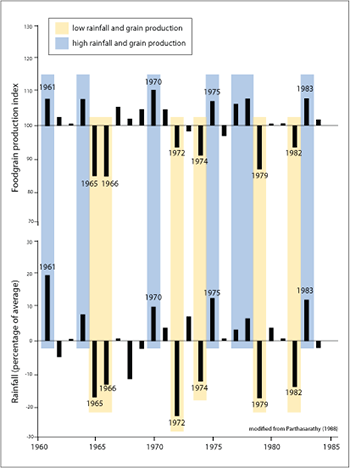
From wheat and rice to vegetables, cotton fiber, and tea, Indian farmers grow a wide range of crops and the country uses more country for crops than any other country in the world (215 million acres). Crops depend on rain and, in Bharat, more than than iii quarters of the annual rainfall occurs during the 4 months of the summer monsoon season. But during years when there is less rainfall than usual, crops die in the fields or cannot exist planted at all. Have a look at the graphs to the left to see how the amount of grain crops produced by farmers in Republic of india (including wheat, rice, and barley) relates to the amount of rainfall. Over half of India's population works in agronomics, and monsoon rains direct affect their incomes and livelihood. Agriculture adds up to more than than fifteen% of India's Gross Domestic Product (Gdp), which means that when crops neglect considering of too little rain, the economy suffers.
While too little rainfall during the summer monsoon can cause dire atmospheric condition for farmers on land, also much rainfall and overly potent winds tin make coastal waters unsafe, preventing fishermen throughout South Asia from heading to sea to take hold of the fish they depend on for income.
Monsoon rains tin exist harnessed as hydropower, a valuable energy resources. Hydropower currently provides 25% of India's electricity. Reservoirs are filled during the summertime monsoon rains and so the water is gradually released through dams, turning turbines to create electricity year-round. During years when there is trivial monsoon rainfall, the reservoirs are not replenished, limiting the amount of hydroelectric power produced during the year.
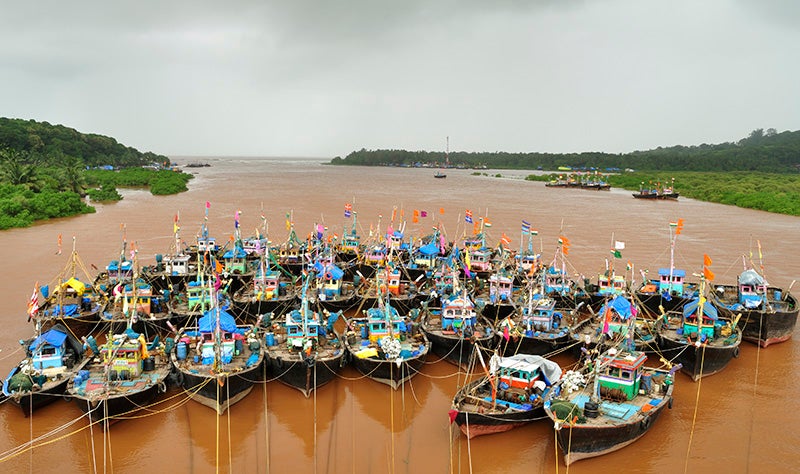
Angling boats in southward Asia
Sandip Dey, Wikipedia Commons
Monsoons and health
Considering regions with a monsoon climate have distinctly moisture and dry seasons, they are prone to floods and droughts, both of which are chancy to health.
During summer monsoons, heavy rainfall tin can cause flooding. Powerful floodwaters can drown victims and damage buildings, leaving people without homes and vulnerable to the elements. During the 2014 summer monsoon in Pakistan and India, nigh 300 people lost their lives during landslides and home collapses. Australia's 2011 monsoon flooding acquired nigh $4.5 billion in damage.
Yet the main health hazards during summer monsoon season are diseases like cholera, dengue, chikungunya, and malaria, likewise as stomach and center infections. Each year, as the summer monsoon season approaches, Indian hospitals fix for loftier numbers of patients with these illnesses.

(left) During months with less rainfall in Bangladesh, in that location is less dengue. (from Karim et al, 2012). (right) Years with heavy rainfall in India tend to have more malaria cases
Magori and Drake, 2013
When floods cause h2o purification systems to get compromised, diseases similar cholera can spread through unclean drinking water. Besides, mosquitos that carry illness breed in open containers that fill with rainwater – from large water barrels and ponds to small kokosnoot shells. Mosquitos that spread malaria, dengue, and chikungunya are mutual in the tropics. Because mosquitoes have more than places to brood during the summer monsoon rains, there are more than mosquitos. That leads to more mosquito bites that spread affliction.
During the winter, clouds rarely provide shade and the dry land surface can't cool off by evaporation, so heat waves are mutual. At to the lowest degree 2500 people died in a major rut wave that swept across India in 2015, and over 1000 died about a calendar month later from a heat wave in Islamic republic of pakistan. Temperatures in New Delhi were nearly 120°F (almost 50°C). Water is scarce at this time of year, which causes water-washed diseases to get mutual; these diseases spread when there is too niggling water for proper hygiene.
Meningitis, which kills one in ten victims, spreads during the dry out flavor in sub-Saharan Africa when desert dust becomes airborne and is inhaled. Typically the number of cases drops with the first monsoon rains.
The number of people affected by both the wet and dry monsoon seasons depends on the population of the affected region. For case, Mali in Due west Africa has a fast-growing population and researchers are investigating how people will cope with the aforementioned limited water resources during the dry out season as the land'due south population grows.
Source: https://scied.ucar.edu/learning-zone/storms/monsoons
0 Response to "What Causes the Itcz to Move So Far North in Asia?"
Enregistrer un commentaire