Did You Know Tonight Is a Full Moon
Full Moon is the virtually hitting Moon stage when the entire confront of the Moon is lit upward.
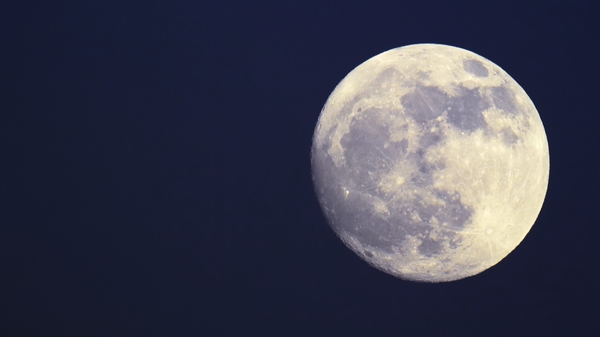
A Full Moon is when the Sun and the Moon are aligned on opposite sides of Earth.
©iStockphoto.com/Sjo
Next Total Moon
17 April 2022, 01:55
Previous Full Moon
18 Mar 2022, 14:17
Times for the Full Moon vary past time zone. Times and dates are based on the local fourth dimension in Jakarta. Change location
When Is the Total Moon?
The Full Moon is when the Sun and the Moon are aligned on contrary sides of Earth, and 100% of the Moon'south face up is illuminated by the Sun (see illustration).
That said, some Full Moons are simply 99.9% illuminated, as seen from Earth. The reason why we cannot see the entire illuminated hemisphere of the Moon during some Full Moons is that the Moon's orbit effectually Earth is inclined at an angle of about 5° in relation to the Earth's orbital plane, the ecliptic. If the Full Moon occurs at a moment when the Moon is above or below the ecliptic, we view the Moon at an angle that diminishes the illumination percentage by a tiny amount.
The Moon is in constant motion around the World, so—technically speaking—the Full Moon merely lasts for an instant of fourth dimension. This ways the exact fourth dimension for Total Moon is during the twenty-four hour period on parts of the planet.
Still, the Moon can appear to exist full a day before or later when more than 98% of the Moon's disc is lit-up. That can make it tricky to tell the difference between a Full Moon and the last stage of a Waxing Gibbous Moon or the beginning of a Waning Gibbous Moon.
The Moon: Our natural satellite
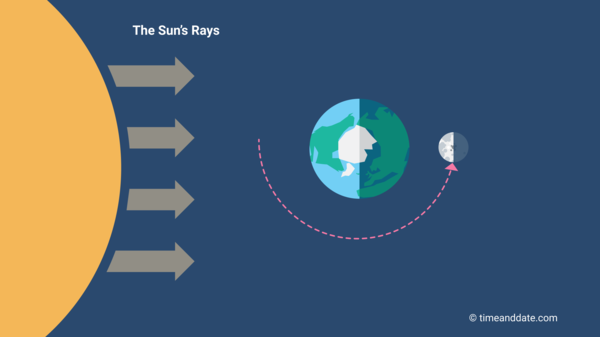
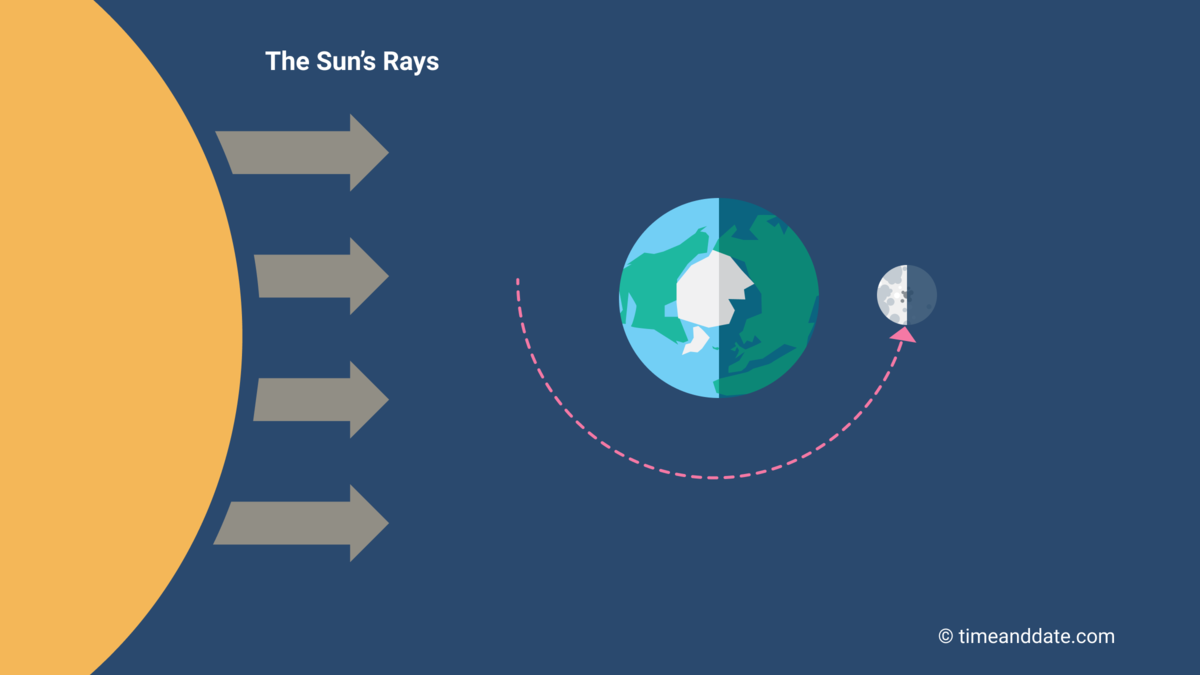
Full Moon is when the Sun and the Moon are aligned on opposite sides of Earth.
©timeanddate.com
Earth Between the Sun and the Moon
The technical term for when iii bodies—such as the Sunday, Earth, and the Moon—are in alignment is syzygy.
When the side of the Moon nosotros tin see from Earth is fully lit upwards at Full Moon, the other side is in darkness. The opposite happens at New Moon.
The Total Moon is visible in the sky from around sunset to sunrise.Generally speaking, at the precise moment of the Full Moon alignment, the Moon is only visible in the night part of Globe. In special cases, notwithstanding, the effect of refraction (as well as the tilt of the Moon'southward orbit) ways that it is possible for the Sun and the Total Moon to be visible at the same time.
The Full Moon Causes Lunar Eclipses
Two or three times a year, the Full Moon phase coincides with the Moon reaching the lunar nodes of its orbit. These are the points where the Moon's orbit crosses the ecliptic, which is the Sun's path, seen from World. When this happens, World casts its shadow on the Full Moon, causing a lunar eclipse.
On the other hand, solar eclipses happen if the Moon comes close to the lunar nodes around New Moon.
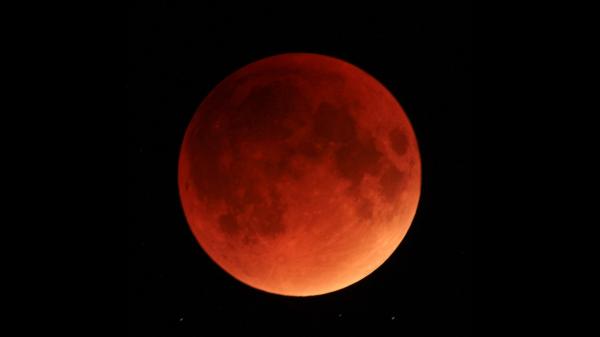
A crimson Moon during a total lunar eclipse on September 28, 2015.
Deanne Fortnam
Supermoon and Micromoon
The indicate of the Moon's orbit closest to Earth is called perigee, and the point farthest away is known as apogee.
When a Full Moon is shut to the perigee, it is known as a Supermoon or Super Full Moon. When a Total Moon is close to the apogee, it is called a Micromoon.
How Many Full Moons in a Twelvemonth?
Most years have 12 Full Moons, one each month. However, our calendar is not perfectly synchronized with astronomical events. Therefore, at present and then, a twelvemonth has 13 Full Moons. When this happens, at least one of those Full Moons is called a Blue Moon.
Lunar Libration: The Rocking Moon
The Moon orbits Globe counterclockwise on an elliptical path when looking downwardly at the Earth's North Pole, and the same side of the Moon always faces Earth. However, over time, the Moon rocks slightly from north to south and wobbles a niggling from due east to westward. This motility, known equally lunar libration, makes information technology possible to meet up to 59% of the Moon's surface from World, although only 50% at a time.
College Tides at Full Moon
The most significant deviation between loftier and depression tide is around Full Moon and New Moon. During these Moon phases, the Moon and the Sun'southward gravitational forces combine to pull the ocean'due south water in the aforementioned direction. These tides are known as spring tides or rex tides.
3rd Principal Moon Stage
Full Moon is the third of the four primary Moon phases, which occur at specific moments in fourth dimension. The other three are New Moon, First Quarter Moon, and Third Quarter Moon.
In addition, in that location are iv intermediate phases that accept up the fourth dimension in between the primary phases. These are Waxing Crescent Moon, Waxing Gibbous Moon, Waning Gibbous Moon, and Waning Crescent Moon.
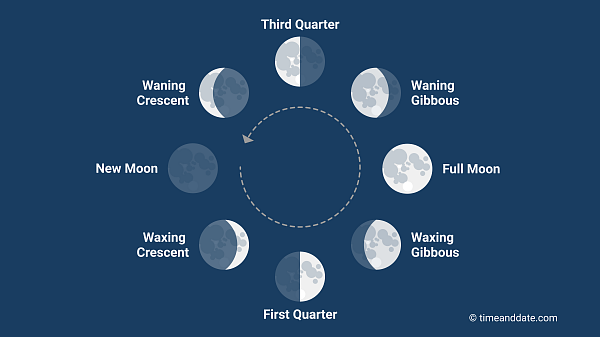
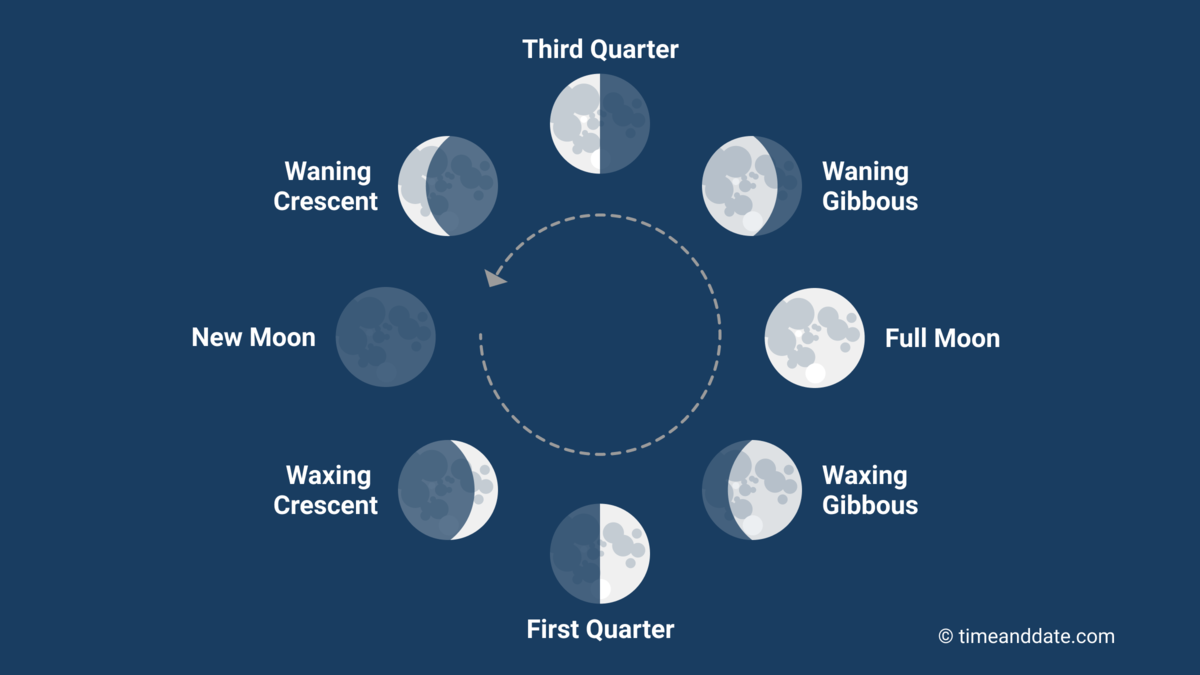
It takes around 29.5 days to move through the eight Moon phases.
©timeanddate.com
Cultural and Religious Significance
The Moon has influenced human culture for millennia, and the Full Moon phase in particular. The engagement for Easter Sun, for example, is adamant based on the Full Moon and the vernal equinox.
The Moon has as well inspired the invention of countless deities, similar the Roman goddess Luna or her Norse male person counterpart Máni, who gave his name to Monday.
In the past, information technology was common to call up that the Moon caused many forms of mental disease, hence the name lunatic. The Total Moon has even been held responsible for supernatural transformations, changing otherwise harmless men into ferocious werewolves.
Even today, people use ancient Full Moon names, like the Harvest Moon and the Strawberry Moon.
Source: https://www.timeanddate.com/astronomy/moon/full-moon.html
0 Response to "Did You Know Tonight Is a Full Moon"
Enregistrer un commentaire